









Breadcrumbing in Dating: What It Means and How to Spot It

Does the person you’re interested in blow hot and cold? Does it feel like they give you just enough attention to keep you around, only to leave you hanging again? You could unknowingly be the target of breadcrumbing.
Dating online has amplified everything about relationships, from creating and strengthening connections to the common tactics people use to navigate them. These usually stem from the perpetrator’s own inability to communicate or manage their feelings, although they can sometimes be a red flag for more sinister behavior.
While most of these dating behaviors have always been around, digital dating has made them much more common and easier to notice. This has given rise to a slew of new terms to describe these behaviors – ghosting, orbiting, love bombing, benching and today’s topic: breadcrumbing.
Over 30% of us have likely experienced breadcrumbing in the last year alone1, and online dating has been found to be a common factor in breadcrumbing behavior. With the ability to hide behind a screen, it’s easier than ever to hide our real feelings and maintain relationships that lack any real depth.
Breadcrumbing leaves its victims feeling confused, betrayed, and emotionally exhausted, and it can be a big red flag for more relationship problems later on. So, what is breadcrumbing, how can you spot it, and what can you do when you suspect you’re being breadcrumbed?
What is Breadcrumbing? Understanding the Meaning
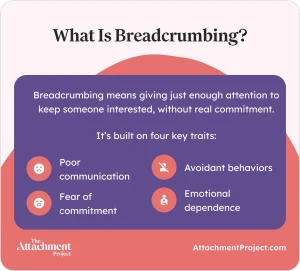
Breadcrumbing is the act of giving somebody small pieces of hope designed to keep them interested, without actually taking things further. It’s named after the trail of breadcrumbs left by fairytale characters Hansel and Gretel, but you can also think of it as somebody offering crumbs to keep you waiting for the cake – but the whole cake never comes.
An example of breadcrumbing might be occasional texts from an ex finding excuses to check-in, but the conversation soon dries up on their end when you give them your attention. In the early days of dating online, somebody you’re interested in could breadcrumb you by regularly suggesting you meet up in person but never actually making plans.
“Breadcrumbing” can also be used in other contexts, like an employer promising raises or promotions that never come to fruition, but it’s most often used in terms of dating.
Lucky for us, researchers have developed a scientifically-tested questionnaire to measure breadcrumbing behavior2. The outcome of this questionnaire gave us 4 key pillars of breadcrumbing:
START YOUR HEALTHY DATING JOURNEY
Poor communication
Sporadic communication is a cornerstone of breadcrumbing. Preferring to interact over social media and avoiding communicating in-person, actively ignoring messages, avoiding talking about feelings, and looking for excuses when partners express a desire to deepen the relationship were all poor communication behaviors associated with breadcrumbing.
Avoidant traits
Unlike their partners, breadcrumbers can comfortably go weeks without communication. When they do make an effort to reach out, it usually comes from a place of loneliness or low self-esteem. When someone is breadcrumbing, they may become uncomfortable when their partner expresses their feelings.
Lack of commitment
When faced with talk of future plans, breadcrumbers become uncomfortable and avoid the conversation. They may give vague and nonspecific answers, attempting to satisfy their partner’s needs without making any real promises. They may blame their partner’s need for commitment on their inconsistent behavior.
Dependence on the partner
Breadcrumbing involves a degree of dependence, where breadcrumbers may feel the need to have someone by their side. Having someone on the hook makes them feel valued and they purposely give their partner hope to create excitement about the future relationship, yet become uncomfortable when their partner expresses deeper feelings.
The Psychology Behind Why People Breadcrumb Others
Our definition of breadcrumbing helps us understand a little bit about why someone would breadcrumb others. There’s a clear pattern of attachment insecurity emerging, but what else could be going on?
In the best case scenario, you may mistake a sudden change in behavior brought about by stress or another external factor for breadcrumbing. However, breadcrumbers tend to be intentional in their behavior, even if they deny that what they’re doing is breadcrumbing – they may even have convinced themselves that what they’re doing is okay or not their fault.
Sometimes, this is because they have convinced themselves that they’re not doing anything wrong – breadcrumbers tend to exhibit moral disengagement, meaning they find justifications for their actions and distance themselves from their consequences3. Toxic disinhibition – the phenomenon where we may feel emboldened to be more critical or unkind behind a screen than we usually would be in real life – also predicts breadcrumbing behavior3.
Psychological distress and being the previous receiver of breadcrumbing are also associated with breadcrumbing behavior3. This paints breadcrumbers in a more sympathetic light, but it doesn’t mean that breadcrumbers are free from responsibility for their actions.
Breadcrumbing and attachment
If you’re wondering whether attachment plays into breadcrumbing behavior, so were researchers in India and Spain in 20234. They predicted that breadcrumbing would be closely associated with insecure avoidant attachment types, as keeping a potential partner at a distance would line up with typical avoidant behaviors.
However, their results surprised them – although they were correct in their assumptions about avoidant behavior, they also found a connection between breadcrumbing and anxious attachment traits. They propose that anxious attachment types could use breadcrumbing as a way to achieve validation and reassurance, or because the “push and pull” is typical of someone with an anxious attachment type.
There was another surprising aspect of their results – which type of attachment was more closely associated with breadcrumbing differed between Spain and India. Breadcrumbing in India was more closely related to anxious attachment traits, while in Spain, breadcrumbing was more closely related to avoidance. This could be because India trends toward a more collectivist culture compared with Spain, which produces differences in how people approach close relationships.
On the opposite side, researchers in Poland found that victims of breadcrumbing scored significantly higher in anxious attachment5. This could be representative of anxiously attached people’s tendency to enter relationships that start off excessively strong and persist when their partner shows a lack of interest.
DISCOVER YOUR ATTACHMENT STYLE
Narcissist breadcrumbing
Breadcrumbing has been associated with two of the three “dark triad” traits, with studies finding that people who have breadcrumbed others tend to score higher on vulnerable narcissism and Machiavellianism5, 6.
Machiavellianism describes a tendency toward self-interest, moral indifference, and the use of deception and manipulation tactics used to achieve self-centered goals.
Vulnerable narcissism differs a little from grandiose narcissism, which is what we usually picture when we talk about a narcissist. Instead of projecting a self-important image of superiority, vulnerable narcissists feel inadequate compared to others. They may be overly sensitive to criticism or rejection, leading them to use manipulative and controlling tactics to avoid rejection. They are heavily focused on their own feelings, so lack the ability to consider those of others.
The reason the researchers believed that vulnerable, but not grandiose, narcissism was linked to breadcrumbing was because grandiose narcissists are less likely to feel the need to project a false image – they don’t crave validation in the same way that vulnerable narcissists do6.
Because of the serious implications of vulnerable narcissism – higher vulnerable narcissism traits are linked with higher likelihood of perpetrating intimate partner violence – researchers have highlighted that breadcrumbing should not be taken lightly6. They suggest that breadcrumbing could be a red flag for more serious relationship problems down the line, so it’s important to know what to look out for.
5 Warning Signs You’re Being Breadcrumbed
The warning signs of breadcrumbing can be difficult to spot, especially when you have genuine feelings for the breadcrumber.
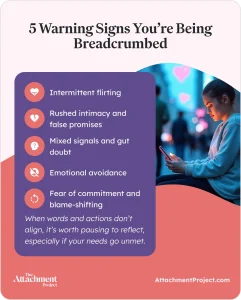
A qualitative research paper published in 20237 interviewed people who had experience breadcrumbing in the past year. They identified 5 common themes of breadcrumbing in dating:
- Intermittent flirting: charming and flirtatious behavior at the very beginning of the relationship, like giving lots of compliments and luring the other person in.
- Pretentiousness: overstating their commitment early on, saying “I love you” sooner than expected, fostering high levels of trust and intimacy.
- Incongruence between words and actions: the breadcrumb receiver might notice mixed signals or have a gut feeling that something is wrong, but they enjoy the intimacy when it’s available and put their doubts aside.
- Avoiding emotional investment: the breadcrumber tends to avoid deeper emotional intimacy, perhaps avoiding seeing the receiver in person and hiding their real feelings.
- Commitment uncertainty: contrary to what they said at the beginning of the relationship, breadcrumbers will avoid making future commitments to the relationship and may place blame on the breadcrumb receiver.
These generally line up with our earlier definition of breadcrumbing, but the qualitative aspect of this study gives us a look into what the breadcrumbing victims noticed themselves. One participant said:
“When you look [at] the world through rose-coloured glasses, even the red flag looks like a normal flag. So, even if you want to, even if you do see, you kind of don’t want to see because you think that, oh, man, right now I am happy, why [am I] destroying my own happiness?”7
Participants in this study also expressed concerns about gaslighting behavior, noticing that their partners had denied making the commitments they’d made at the beginning of the relationship and blamed them for seeking more than they were willing to give.
The psychological impact of breadcrumbing
Breadcrumbing takes a heavy psychological toll on the victim, with many reporting low self-esteem and life satisfaction, depression, loneliness and helplessness7, 8. Breadcrumbing victims may find it more difficult to trust in future partners, and may even be more likely to go on to breadcrumb someone else3.
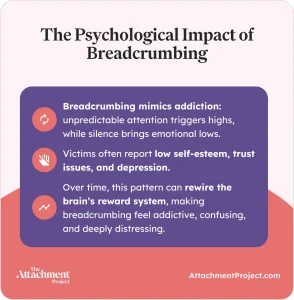
The excitement a breadcrumb victim feels when given hope produces a kind of high. The intermittent and unpredictable nature of this high mimics models of addiction9, where unpredictable but occasional rewards keep you craving more. Think of how a slot machine could result in a win at any time, but the jackpot almost never comes. Just when you’re about to give up you’ll receive a small prize to make you feel like winning is possible and keep you hooked – breadcrumbing follows the exact same pattern.
How breadcrumbing alters brain chemistry
When your brain’s reward center has been overstimulated like this for a long time, its baseline changes. You begin to need the reward to feel normal, and without it you experience low mood and stress. When you look at it this way, it makes sense that breadcrumbing victims report significant lows that impact them beyond the scope of relationships.
If you’ve been on the receiving end of breadcrumbing, experiencing a craving for this person and lows when they’re not around is just how your brain is wired – during evolution this wiring would’ve helped us survive when food was scarce. All of our brains are wired this way, though some may be more sensitive to the reward system than others. For example, if you have ADHD you may be more sensitive to reward, making the highs higher and the lows lower than they are for others10.
Other people who have been breadcrumbed report that they continued to pursue the relationship because of hope or anticipation of reciprocation (in line with the addiction theory), because they felt guilty for not giving the breadcrumber a chance, because they lacked healthy boundaries, or because the breadcrumber fulfilled their emotional or sexual needs in the short term7.
How to Respond to Breadcrumbing
If you suspect you’re currently being breadcrumbed, recognizing the signs is the first step towards a solution. Understanding what you need and what has to change helps you to set healthy boundaries and redefine your relationships with others and yourself.
You may wish to communicate with the breadcrumber about what you’re experiencing and how you feel – like we mentioned earlier, in the best case scenario, their change in behavior could be explained by something else. However, if the conversation leaves you feeling less certain than before and questioning your own perception of what’s happening, or if nothing seems to change afterwards, it might be time to consider that this person is actively breadcrumbing.
5 Key Coping Strategies for Dealing With a Breadcrumber
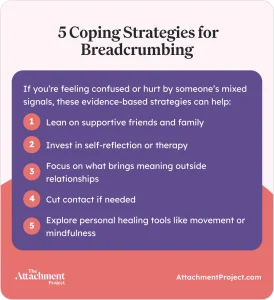
People who have been breadcrumbed report that 5 key coping strategies helped them to move on7:
- Social support: investing more time in family and friends who foster positive relationships helped breadcrumbing victims to build trust and connection in others and restore their self-esteem. Talking to trusted people about breadcrumbing, and in some cases sharing experiences online, helped to process emotions and understand what happened.
- Self work: As well as their relationships with others, breadcrumbing victims found that investing in themselves helped them to understand what happened and move forward. Therapy is a popular route to self work, but self work can also include spending time on enjoyable activities, finding a sense of purpose, and prioritizing yourself over others.
- Distraction: Focusing on aspects of life outside of romantic relationships like health, career, and travel plans helped breadcrumbing victims to divert their attention from the breadcrumber.
- Cutting of the relationship: Breadcrumbing victims find that cutting contact with the breadcrumber helped them to “regain their strength and get out of the toxicity”. Some initiated a conversation with the breadcrumber to find a sense of closure, but others preferred to move on without a discussion.
- Personal techniques: We all have different coping strategies, and breadcrumbing victims used a variety of these to help them to recover. These included exercise, meditation, and spirituality.
Building Healthier Dating Habits
Building healthy dating habits can help you to avoid experiencing breadcrumbing and other modern dating pitfalls.
Our Dating Toolkit gives you practical tools and resources to use before, during, and after dating to help you to better navigate relationships with others, and the most important relationship of all – your relationship with yourself.
START YOUR HEALTHY DATING JOURNEY WITH OUR DATING TOOLKIT
Conclusion
Breadcrumbing is a troubling dating phenomenon, amplified by social media’s ability to keep us distanced yet connected to one another. Breadcrumbers tend to justify their behavior and struggle with empathy, often placing the blame on the victim. This can have devastating consequences, leaving the victim feeling confused, low, and hopeless. Feeling this way is an understandable response – your brain is wired to seek reward in scarcity – but fostering positive relationships with others and yourself can help you to find yourself again and move on from breadcrumbing.
FAQs
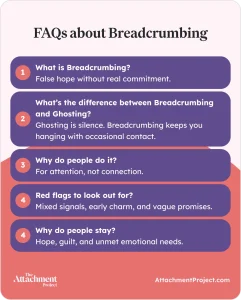
What’s the difference between breadcrumbing and ghosting?
Ghosting is when somebody suddenly disappears from your life without an explanation. When someone is breadcrumbing, they may be absent from your life a lot of the time, but they’ll throw you occasional “breadcrumbs” to keep you interested in the relationship.
What does it mean to breadcrumb someone?
Breadcrumbing is when someone gives you hope for a relationship without making any real commitments. They might go weeks without contact and get in touch when they feel lonely and need validation, only to disappear again when they’ve got what they need.
What do breadcrumbers want?
Breadcrumbers typically want the validation and good feelings associated with having someone interested in them, but they don’t want to make any real commitment. They want to keep you on the hook, but they’re only interested in communicating with you when it benefits them.
What are the red flags of breadcrumbing?
At the beginning of the relationship, the breadcrumber can come off as very charming and flirtatious. They may show signs of love-bombing, using “I love you” statements earlier than expected and potentially making promises and expressing commitment. However, as the relationship progresses, they pull away and their communication becomes sporadic. At this point, you may have a gut feeling that their words don’t line up with their actions. Eventually, the breadcrumber may deny ever talking about the future and avoid any more conversations about feelings or commitment.
Why do people continue to respond to breadcrumbers?
Breadcrumbing mimics models of addiction, and our brains are wired to continuously seek reward when it comes irregularly. People who have been breadcrumbed also report they continued to respond because they were hopeful, felt guilty if they didn’t take the chance on the breadcrumber, lacked healthy boundaries, or felt the breadcrumber fulfilled short term emotional or sexual needs.
References
- Olivas RN, Rubio EL, Jiménez SY, Galindo BV. Ghosting and breadcrumbing: prevalence and association with online dating behavior among young adults. Escritos de psicología. 2020;13(2):46-59.
- Rodríguez-García MC, Márquez-Hernández VV, Granados-Gámez G, Aguilera-Manrique G, Martínez-Puertas H, Gutiérrez-Puertas L. Development and validation of breadcrumbing in affective-sexual relationships (BREAD-ASR) questionnaire: introducing a New Online dating perpetration. International journal of environmental research and public health. 2020 Dec;17(24):9548.
- Cobzeanu A, Măirean C. Online Fairytales: Breadcrumbing and Ghosting Behavior Among Young Adults. Deviant Behavior. 2025 Feb 5:1-20.
- Khattar V, Huete N, Navarro R. Attachment insecurity and breadcrumbing engagement in young adults: a cross-sectional, cross-country study in India and Spain. BMC psychology. 2023 Oct 25;11(1):356.
- Azzato I. I zostały tylko okruchy… Dlaczego polskie użytkowniczki i użytkownicy Tindera stosują breadcrumbing?.
- Willis ML, Oliver E, March E. Dating in the dark: Vulnerable narcissism predicts inauthentic self-presentation in online dating. Telematics and Informatics. 2023 Jun 1;81:101985.
- Khattar V, Upadhyay S, Navarro R. Young adults’ perception of breadcrumbing victimization in dating relationships. Societies. 2023 Feb 8;13(2):41.
- Navarro R, Larrañaga E, Yubero S, Víllora B. Psychological correlates of ghosting and breadcrumbing experiences: A preliminary study among adults. International journal of environmental research and public health. 2020 Jan;17(3):1116.
- Clark L, Zack M. Engineered highs: Reward variability and frequency as potential prerequisites of behavioural addiction. Addictive Behaviors. 2023 May 1;140:107626.
- Paloyelis Y, Mehta MA, Faraone SV, Asherson P, Kuntsi J. Striatal sensitivity during reward processing in attention-deficit/hyperactivity disorder. Journal of the American Academy of Child & Adolescent Psychiatry. 2012 Jul 1;51(7):722-32.
 Get mental health tips straight to your inbox